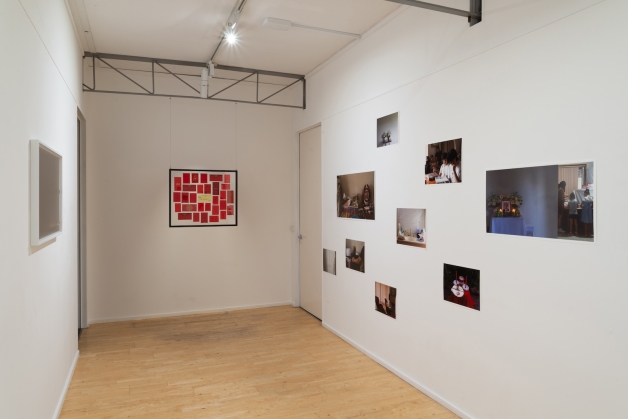
Artist talks: VIEW2026
Join us for artist talks with VIEW2026 artists Cass Li, Elesa Stellios, and Toni Tait.
photo access
HYPERSPECTRAL25 is an immersive outdoor evening event that features contemporary digital media, video, and audio installations. Happening Saturday, March 1st from 7-10 pm at photo access, the 2025 edition will focus on the themes of “realities, synthetic realities, and consciousness.”
Now in its third year, the event showcases local, national, and international artists who are at the forefront of emerging technologies. It offers a diverse program that celebrates the fusion of creativity, experimentation, art, and science.
HYPERSPECTRAL25 will participate in ENLIGHTEN: BEYOND, an initiative that illuminates Canberra’s National Attractions and local organisations after dark through a stunning display of light, sound, and movement.
Curated by Maddie Hepner.
This is a free event but registration is required.
Supported by Events ACT
Being represented by data is like losing a part of yourself, 2024, AI video,
04:43
Being represented by data is like losing a part of yourself is an AI generated video work, which reflects on the conflicting natures of gender, bodies, queerness, algorithms, data, glitches and artificial intelligence.
The artwork considers how algorithms and data rely on categorical understandings to act upon the world, and how this methodology stands in stark contrast to how queer identities are inherently outside of category and binary perceptions. By actively misusing artificial intelligence technologies, the work seeks to discover queer modes of expression within the glitchiness of algorithmic spaces. With digital technologies becoming more and more ubiquitous, the video acts as a queer rebellion against the current paradigms of the binary.
The image and voice AI models are trained on the artist’s own data, and the music and text is written specifically for this video without the use of AI.
Ada Ada Ada (she/they, 1992, Denmark) is an algorithmic artist, who works with gender, queerness and bodies as perceived by computers through algorithms, software, “artificial intelligence” and more.
Ada moves between art forms, and so far, her practice has included performative photography, video, generative art, net art, writing, interactive installations as well as live “artificial intelligence” performance.
The question at the heart of Ada’s art practice is: How can algorithms be used to understand and challenge experiences of gender and bodies in novel ways?
She combines data, theory and computation to view human experience through new lenses and perspectives.
Her work often deals directly with societal struggles, concerns and politics, for example through data visualization or performative engagements, and her identity as a trans woman often informs the work she does.
Drive-in, 2025, video projection in vehicle, dimension variable
_____ and _____ sitting in a tree, K-I-S-S-I-N-G.
In this video installation, Cheung explored her own complicated feelings towards desire, comprising a mix of discomfort, confusion and yearning. Drive-in illustrates the ambiguity in queer coming-of-age experiences, represented by disembodied, genderless parts.
A single car, parked at night.
As you may well know, what goes on out of sight.
Celine Cheung is a visual artist based on unceded Dharug land (Western Sydney). Working across performance, installation and image-making, she uses symbolic gestures to explore relationships and affective life. Her art is often guided by visceral responses to love and loss, but she is also interested in excavating the uncanny, uncomfortable or embarrassing.
Since completing a BFA/BA at UNSW Art & Design, she presented projects and exhibitions at Firstdraft, Diversity Arts Australia, AirSpace Projects etc. She was the recipient of the HIDDEN Sculpture Prize in 2023, and a finalist at the 68th Blake Prize and Burwood Art Prize. She is a Co-director of artist-run gallery Pari and a 2024-25 resident at Parramatta Artists’ Studios Granville.
The Pet Shop, 2024
The Pet Shop is an experimental stop-motion animation film that explores the fragile boundaries between physical reality and its digital manifestations through the lens of being on the schizophrenia spectrum.
The story centres on Louise, a pet shop assistant, as she navigates the blurred lines between the real and synthetic. Louise and her companion try to understand why no one is entering The Pet Shop.
Esther Forest is a mixed media artist, based in Boorloo on Whadjuk Noongar Boodjar (Perth) specializing in stop-motion films and diorama-based world-building. Drawing from personal experiences, they create films that blend sci-fi, horror, and humour to explore social interaction, alienation, and magical thinking. Forest subverts stereotypes of schizophrenic characters by portraying them as protagonists with vulnerabilities, reflecting her own experiences on the schizophrenia spectrum.
Glass Thing, 2025, live performance of improvised visuals and sound
Experience the improvised projections and sonic explorations of Nicci Haynes & Sebastian Field. Synths, ambient guitar, and haunting vocals intertwine with mesmerizing visuals, creating a dynamic interplay of sound and image riffing off one another.
These live performances are spontaneous compositions—unexpected journeys of wild immersion.
Live drawing performance in collaboration with dancers and musicians has become a significant component of Nicci Haynes’s practice, events at which experimental languages spontaneously emerge between artforms. For Haynes improvisation and inventiveness is the common element throughout a diverse art practice with experimental film frequently serving as a vehicle to capture liveness and movement. The serial nature of film processes allows diverse elements to exist within a single container.
Nicci lives and works on unceded country of Ngunnawal, Ngunawal and Ngambri peoples.
Sebastian Field is Canberra/Ngunnawal country-based musician, whose music has been described ‘as powerful as it is elegiac’ – BMA Magazine, and comprised of ‘widescreen sound worlds’ – Cyclic Defrost. Field has an extensive history of producing and touring original music and is affiliated with experimental label Provenance Collective. His debut solo album ‘Picture Stone’ saw Field demonstrating well established experimental pop sensibilities which his sophomore album ‘Sandcandles’ rejected staunchly, trading Field’s hallmarks of a more traditional songwriting and ethereal vocals for electronic textures and landscapes populated by immersive fogs of ambience, skittering flourishes of plastic percussion and avant-garde vocal production, akin to Intelligent Dance Music of the early 1990s. He followed through with ‘Prescients EP’, wading further into experimentation with ambience, texture and tone, and is set to release a trove of processed ambient guitar recordings any day now.
Van Damme, 2019, moving image with sound, approx 3min seamless loop
Van Damme presents a form of abstract still life. The sculptural forms are composed of trashy clips appropriated from YouTube – the largest online platform for video sharing – and a mediated space of consumption, voyeurism, and cheap entertainment. Clips of Jean-Claude Van Damme performing in front of a green screen, or a rotating asteroid are ripped from the platform, duplicated and layered multiple times to create a virtual floral like assemblage. Ives’ video works perform alchemy on this spam, transforming it into a mesmerising, aesthetically beautiful composition and making this collapse of high and low culture, and the material and immaterial, an object of contemplation.
Harley Ives is a Sydney based artist. His works are concerned with the material qualities of the moving image and how they can be directed to discern a painterly quality in video. In part this is a response to the dematerialization of images in a Post Internet age and seeks to explore the aesthetics of image decay. Recently his practice has instigated a collision between real and virtual sets in order to bring to view our relationship to synthetic imagery.
Harley has been included in group exhibitions nationally at venues including Artspace Sydney, Campbelltown Arts Centre, Griffith University Art Museum, RMIT Melbourne, and held six solo exhibitions at Chalk Horse Gallery, Sydney. Currently, Harley works as a lecturer in Screen Arts at Sydney College of the Arts and in Photomedia at The National Art School. In 2018 he completed a Fine Arts PhD with a thesis titled The Material Qualities of the Moving Image and the Painterly Gesture.
Screen life archive, 2024
I started documenting my life via camera a couple of years ago. I film not so often, only if in the mood. However it became an important practice to me when I understood how many moments from my own life I can’t recall, how strong my idea of me is and keeps playing in my head on loop. Also with the camera I feel like I try to fight with time.
In the video Screen life archive there is my archive played a bit randomly to remind me that I actually have lived different lives under different circumstances.
Intizor Otaniyozova is a multidisciplinary artist based in Central Asia. Themes of her research are identity, ecology, feminism and Beyoncé. Participated in exhibitions in different countries of Asia and Europe. Also was published in literature volumes. “Ashes to Ashes, Dust to Side Chicks” is her debut feature-length documentary film in development.
World Worry Web, 2024
Pliamko shows how new ways of moving information have affected our sense of self. This idea was born from a long search for the grail of normality in personal therapy. She found the versatility and sources of anxiety symptoms in the concept of the philosopher Marshall McLuhan about how invented technologies are an extension of our bodies. And by inventing a global network, we get one external nervous system for everyone, sensitive to all changes in the world.
Pliamko graduated from the Institute of Contemporary Art in Ukraine with a specialization as an artist. Since 2007, she worked as a designer and illustrator, and exhibited as an artist exploring memory, and connections between inner and outer worlds. Additional education in animation, visual communication, and psychotherapy contributed to this. After the war began, she moved to Estonia and acquired here direction skills. While my symbolism-laden works are exhibited in different countries in illustrative and entertainment contexts, since 2022 she has started creating animated films about technology and the psyche at home and participating in film festivals with them.
Unreal, 2020, single-channel high definition video, 16:9, colour, sound, 3 minutes 30 seconds
Humanity has long been observed, studied and synthesised with our technology. As we move ever closer to a technological singularity, the line between carbon and artificial-based life becomes ever more blurred.
Unreal utilises 85 individual AI generated portraits created through a Generative Adversarial Network.
Ollie Poppert is a Sydney-based video artist working primarily in digital video and photography.
His work focuses on concepts of time and space, abstract representations of spaces and people with a particular interest in urban environments and how they are inhabited. My goal is to create immersive, expressionistic work using unconventional methods of photography and film.
500ml/point, 2024, single-channel HD video (colour, sound), 00:11:08.
500ml/point is a cost-benefit analysis of outsourcing your art practice to artificial intelligence. The work’s title refers to the vast quantities of water required to build, use and maintain AI systems. Responding to data-driven approaches to art and culture that often frame AI as an innocuous tool for creative practice, 500ml/point playfully explores its entanglement in broader economies and emergent crises. The work is assembled from materials produced on various AI platforms and text appropriated from AI advertisements which it uses as vehicles for critique. Through multiple mediated performers, it explores questions of cultural authority and liveness in the era of YouTube and Stable Diffusion.
Litia Roko is an artist interested in the politics of technology and the politics of art. Her practice investigates the ways networked technologies have ruptured and reshaped visual culture and social life. Primarily concerned with the production and circulation of images in computational culture, her work interrogates their post-representational dimensions as datapoints within systems of extraction. Working across video, performance, installation, and text, her practice picks at questions raised by the datafication of everyday life and explores the challenges network culture poses for established notions of cultural value and authority. Litia lives and works on unceded Ngunnawal land and recently graduated from the ANU School of Art and Design with First Class Honours. In 2025 she is an artist in residence at Canberra Contemporary and M16 Artspace.
cuadros, 2025, 4 channel video, 4x 1280×1920
Inspired by Dubois’ “photographic act” in which he defi nes the creation of spaces through framing, ‘cuadros’ presents four interconnected scenes where frames appear, morph, evolve and disappear. While their existence is short lived, the frames invite the audience on a journey of escapism into the abstract melting of colours, shapes and ideas.
The sonic landscape guides the audience into a rhythmical, non-linear, timeline that keeps on building on top of itself. It doesn’t have a beginning or end. Instead it’s a never dying sequence that has existed long before the viewer gazes upon it, and will continue to do so after they are gone.
The ever-evolving scene alludes to the impossibility of stillness: the constant movement of sound, image, and life. ‘cuadros’ leverages digital technologies to create a space where the real and the constructed intertwine. It proposes a space of constant transformation where new realities are continuously built upon.
Federico Torres is a new media artist working across different mediums, mainly sound and video. His work focuses on the exploration and exploitation of the co creation dynamics between humans and computers. Through it he strives to work with themes of identity, the self in the digital age and the visualisation of invisible forces and patterns.
Using generative, procedural and modular techniques he develops projects where music and image embrace each other. The visual aspect responds to the audio in real time. The visual exploration combines both computer-generated images as well as analog footage that is later digitally manipulated, while the sonic landscapes are made out of a mix of extensive sound design, sampling, fi eld-recording and randomness.
He uses time-based media to his advantage to explore abstraction focusing on the ephemeral and ever-changing nature of phenomena like time and memory.
Join us for artist talks with VIEW2026 artists Cass Li, Elesa Stellios, and Toni Tait.